
Designing to Scale: What It Is and Why It's Important
Scale is a crucial detail across any design-related field: industrial design, interior design, graphic design, etc. Scale defines the size of an item in relationship to something else. An important guideline in creating any deliverable, whether it’s a building, a space, or an image - scale is often the secret ingredient that destroys or refines a project.
What Is “Designing to Scale”?
In practice, designing to scale can be an extremely challenging technique to master. At its foundation, however, it is the playbook that dictates the position and spacing of every element in a design. Scale guides and forms visual coherence.
There are set rules that determine proper scale, but once these concepts are mastered, designers are able to manipulate scale to convey a unique insight to their viewer. The combination of scale rigidity, a set of rules that work, and liberty - rules that are altered for design emphasis, eludes many designers, even some seasoned professionals. It is necessary, therefore, to collaborate with a team that understands both.
Three Ways Design Is Impacted
Scale shapes the world of design by regulating a project’s relativity, functionality, and adaptability.
Relativity
This area of design refers to the relation a project has with everything around it. To understand this aspect of scale, the designer must determine which relationships matter to the project. In product design and architecture one of the types of scale we have to consider is human-scale. For example, the handle of a child’s spoon needs to ergonomically fit in a child's hand, but the bowl of the spoon needs to be scaled to fit appropriately into the child's mouth.
Each area of relationship needs to be considered in totality. Then the applicable ones need to enhance the project’s relativity scale. It is in this area that a designer can create depth and focus through manipulating the size of one object in relation to another, creating a statement piece.
Functionality
For this area, the designer is focusing on the intended function of the project. How is it used and who is using it? The performance of your design depends heavily on accurate functionality. It has to do what it is meant to do while being accessible to your target audience. If your child cannot open and operate the water bottle designed for them, then the scale is off. A child requires a separate scale than an adult. Constant zooming in and out is necessary to ensure that the scale you are detailing and exploring permits accurate characteristics and performance.
Adaptability
A design must perform in the way it is meant to. However, if it can adapt to several different scales, such as that parent and child sharing the same water bottle, the project is strengthened considerably. Designers with an efficient grasp of how scale affects adaptability will look for ways a project can operate on multiple scales and how to perfect that adaptation.
Scale vs. Proportion
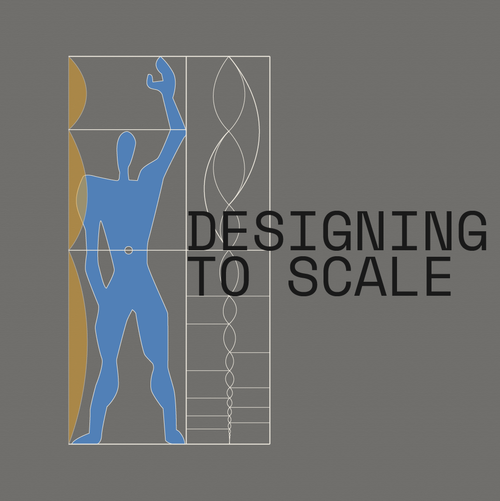
In the design world, scale and proportion are terms that are often used interchangeably. There is one subtle difference. While scale refers to the comparison of objects whose size is known, proportion pertains to the general size of two objects whose sizes (or scales) are unknown. This makes proportion much more ambiguous than scale. Designers are often unable to explain why there is proportion. It is simply something that an experienced designer knows. The most well-known universal scale of proportion in design remains The Modular, created by architect Le Corbusier in 1946. He sought to measure and reconcile math, the human form, architecture, and beauty into a single system. Everything in design, Le Corbusier believed, should come back to a relationship with humanity: “To answer the formidable problems of our times on the means of our society there is only one acceptable criterion, which will trace every problem back to its roots: that criterion is man”. At Joba, we follow in Le Corbusier’s footsteps as we create experiences especially for real people. We tell stories and solidify dreams. Because of this, it is necessary that we understand how designing to scale impacts each individual. Scale is not only a physical aspect of design, it is also an emotional and psychological one. Every person responds to a project or design in a different way. Finding that perfect proportion that speaks to each client’s audience is always a rewarding moment in our field.
